
Arc-Quenching Principles in Switching Devices
I. The arc phenomenon. 1. An electric arc is a discharge phenomenon in which energy is concentrated, temperature is very high, and brightness is intense. For example, when a 10kV oil circuit breaker interrupts a current of 20kA, the arc power can reach more than 10000kW, causing intense physical and chemical changes in the medium in and around the arc.
I. The Arc Phenomenon
-
An electric arc is a discharge phenomenon in which energy is concentrated, temperature is very high, and brightness is intense. For example, when a 10kV oil circuit breaker interrupts a current of 20kA, the arc power can reach more than 10000kW, causing intense physical and chemical changes in the medium in and around the arc. This may burn out the contacts and other components near them. If the arc persists for a long time, it can burn out electrical equipment or even cause an explosion, endangering the safe operation of the power system and causing major losses. Therefore, when interrupting a circuit, the arc must be extinguished as quickly as possible.
-
An arc is a conductor. Although the contacts of a switching device have separated, if an arc remains between them, the circuit is not yet open and current continues to flow.
-
An arc is a self-sustaining discharge phenomenon. Once an arc forms, the voltage required to keep it burning steadily is very low. For example, in air, the arc-column voltage of a 1cm-long DC arc is only 15-30V; in transformer oil, it is only 100-200V.
-
An arc is a stream of ionized gas. It is very light and easily deformed, and external forces (such as the flow of gas or liquid or electrodynamic forces) can make it move, lengthen, or bend rapidly. This is especially noticeable for an arc exposed to the atmosphere. For example, when interrupting a 110kV, 5A AC current in air, the arc length exceeds 7m. The arc can move at speeds of tens to hundreds of meters per second.
II. Arc Initiation and Maintenance
-
Strong-field emission. When the contacts of a switching device separate, the pressure between the moving and stationary contacts continuously decreases and the contact area becomes smaller, causing contact resistance to increase and temperature to rise sharply. At the same time, when the contacts first begin to separate, the gap between them is very small. Even if the voltage is low—only a few hundred or even a few dozen volts—the electric-field strength is very high. For these reasons, the cathode surface may emit electrons outward; this phenomenon is called strong-field emission.
-
Thermionic emission. Contacts are made of metal, which contains a large number of free electrons even at normal temperature. When a switch interrupts a circuit, the large current is cut off at the instant the contacts separate, producing an intense hot spot on the cathode. Electrons are then emitted from the cathode surface in all directions; this phenomenon is called thermionic emission. The number of emitted electrons depends on the cathode material and surface temperature.
-
Impact ionization. Electrons emitted from the cathode surface accelerate toward the anode under the force of the electric field and continuously collide with neutral particles. If the electric field is sufficiently strong, the force on the electrons is sufficiently large, the free path between successive collisions is sufficiently long, and the electrons accumulate sufficient energy, then a collision may ionize a neutral particle, producing new free electrons and positive ions. This phenomenon is called impact ionization. The newly produced free electrons accelerate in the electric field and may in turn collide with neutral particles, causing further impact ionization. As a result, the gap between the contacts fills with large numbers of free electrons and positive ions. The resistance between the contacts becomes very low; under the applied voltage, the charged particles move directionally and form a current, breaking down the medium and forming an arc.
-
Thermal ionization. Neutral particles at high temperatures undergo intense thermal motion. The ionization resulting from their collisions is called thermal ionization. Its role is to sustain the arc. Gases generally undergo thermal ionization at 9000~10000℃, while metal vapor does so at approximately 4000~5000℃. Because an arc always contains some metal vapor and the arc-column temperature exceeds 5000℃, thermal ionization is sufficient to sustain the arc.
III. Deionization of the Arc
Deionization: As the medium in an arc produces large numbers of charged particles through ionization, the opposite process, in which charged particles disappear, also occurs; this is called deionization.
-
Recombination: The phenomenon in which oppositely charged particles attract one another and neutralize to form neutral particles. In an arc, electrons move much faster than positive ions, so direct recombination of electrons and positive ions is unlikely. Recombination instead occurs with the help of neutral particles: an electron first attaches to a neutral particle as it moves, forming a negative ion; positive and negative ions of roughly equal mass and velocity then recombine to form a neutral particle. Since recombination is possible only when the relative velocity of the ions is low, blowing the arc with liquid or gas, or forcing it into a narrow gap with a cool insulating wall, can rapidly cool the arc, reduce ion velocity, and promote recombination. Increasing gas pressure and therefore gas density also promotes recombination.
-
Diffusion: The escape of charged particles from the arc column into the surrounding medium. Diffusion occurs because charged particles move irregularly, because their density inside the arc is higher than outside it, and because the temperature inside the arc is much higher than that of the surrounding medium. The greater the temperature difference between the arc and its surroundings and the greater the difference in charged-particle density, the stronger the diffusion. High-voltage circuit breakers often use gas blasts to carry away large numbers of charged particles and strengthen diffusion. The positive and negative ions that diffuse outward recombine more readily as they cool, forming neutral particles. If ionization exceeds deionization, the arc current increases and the arc burns more intensely; if ionization equals deionization, the arc current remains unchanged and the arc burns steadily; if ionization is less than deionization, the arc current decreases and the arc eventually extinguishes. Therefore, to extinguish an arc, measures must be taken to strengthen deionization and weaken ionization.
IV. Arc Characteristics
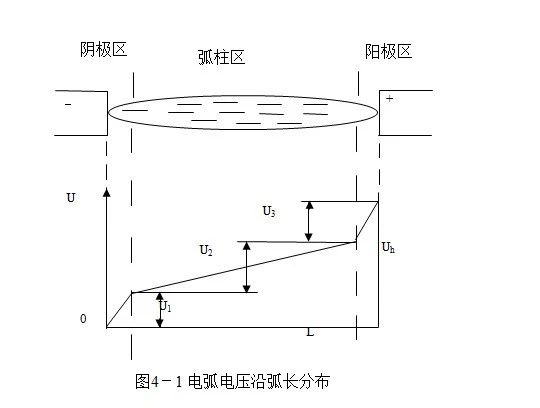
- Distribution of arc voltage along the arc length. After an arc forms, the arc voltage distribution along its length can be divided into three parts, as shown in figure 4-1. The arc-voltage drop consists of the cathode voltage drop U1, the arc-column voltage drop U2, and the anode voltage drop U3; that is, arc voltage Uh=U1+U2+U3.
-
Classification of arcs by voltage distribution (1)Long arc: The distance between the electrodes is long, so the cathode and anode voltage drops can be ignored. (2)Short arc: The distance between the electrodes is short, so the arc-column voltage can be ignored.
-
Voltage-current characteristics of the arc (1)Voltage-current characteristics of a DC arc
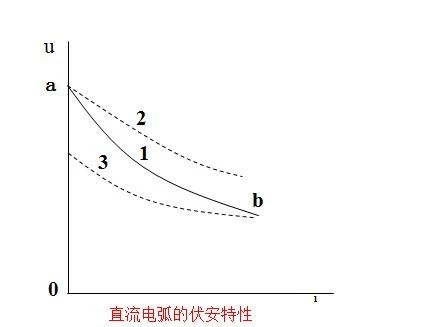
Curve 1 represents a slowly changing current. At every point on the curve, ionization and deionization have reached equilibrium and the arc is burning steadily; this is therefore called the static characteristic.
Curve 2 shows the current increasing rapidly from point a.
Curve 3 shows the current decreasing rapidly from point b.
(2)Voltage-current characteristics of an AC arc
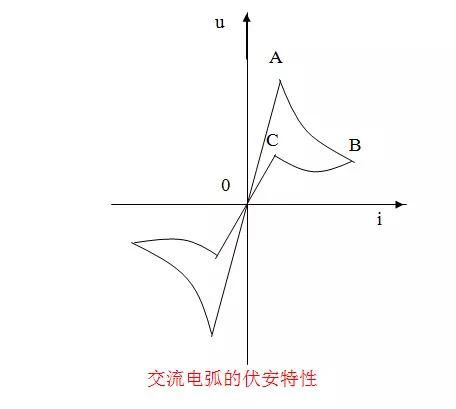
In an AC circuit, the instantaneous current changes continuously with time. The arc therefore has dynamic characteristics, and the AC current passes through zero once every half-cycle. When the current passes through zero, the arc extinguishes automatically. If the arc is burning steadily, it reignites in the next half-cycle after extinguishing at the current zero crossing.
V. Methods for Extinguishing a DC Arc
-
Increase the circuit resistance.
-
Divide a long arc into multiple short arcs.
-
Increase the arc length.
-
Bring the arc into close contact with arc-resistant insulating material.
VI. Conditions for Extinguishing an AC Arc
-
Recovery of the dielectric strength of the arc gap
-
Recovery of the arc-gap voltage
-
Condition for extinguishing an AC arc: ud(t)>ur(t)
(1) Recovery of the Dielectric Strength of the Arc Gap
-
Recovery process of the dielectric strength of the arc gap. Before the arc current passes through zero, the space in the arc gap is filled with electrons and positive ions. After the arc current passes through zero and extinguishes, the electrode polarity reverses. The electrons in the gap rush rapidly toward the new anode. Positive ions, whose mass is more than a thousand times that of electrons, remain nearly stationary by comparison, so a positive space charge forms near the new cathode.
-
Distribution of charge and voltage across a short arc gap after current zero. As shown in the figure, most of the voltage falls across a thin layer of space near the cathode. The dielectric strength of this thin layer is approximately 150~250V. Near-cathode effect: the phenomenon in which the dielectric strength rises suddenly near the cathode.
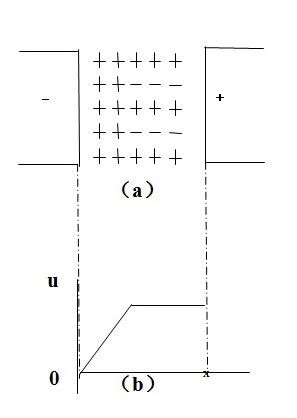
(2) Recovery of the Arc-Gap Voltage. The arc-gap voltage recovery process, that is, the change in recovery voltage, is related to circuit parameters and the nature of the load. Basic methods for extinguishing an AC arc
-
Use an arc-quenching medium with strong arc-extinguishing capability.
-
Blow the arc with gas or oil.
-
Use special metal materials as the arc-quenching medium.
-
Use multiple breaks to extinguish the arc.
-
Increase the speed at which the circuit-breaker contacts separate.
-
Arc-quenching methods for low-voltage switches
(1)Use a metal arc-quenching grid.
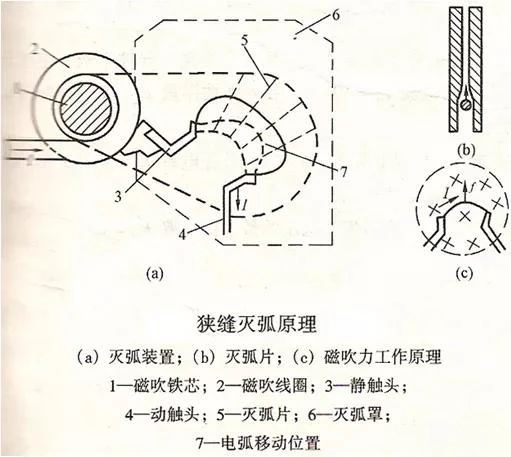
(2)Use a narrow gap in a solid medium to extinguish the arc.
① Transformer oil: Under the high temperature of an arc, transformer oil decomposes and produces large quantities of hydrogen and oil vapor. The insulating and arc-quenching capability of hydrogen is 7.5 times that of air.
② Compressed air: Pressure: 2MPa. The molecular density is high and the free path of the particles is short, making ionization unlikely.
③ SF6 gas: A gas with strong electronegativity. Fluorine atoms have a strong ability to capture electrons and can quickly capture free electrons to form negative ions, which promotes recombination.
④ Vacuum: When the vacuum pressure is below 133.3×10⁻⁴Pa, the gas is rarefied and there are very few free electrons and neutral particles in the arc gap. The likelihood of impact ionization is greatly reduced. In addition, both the difference in charged-particle concentration between the arc column and its surroundings and the temperature difference are large, which promotes diffusion. Its insulating capability is greater than that of transformer oil, SF6 at 1 atmosphere, and air.
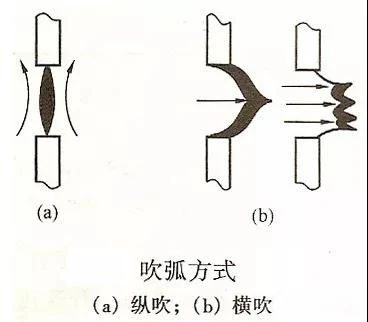
High-voltage circuit breakers use arc chambers designed in advance to make gas or oil generate enormous pressure under the high temperature of an arc, and use nozzles to produce a powerful arc blast. This both transfers heat by convection and strongly cools the arc gap, and also partly replaces the ionized gas or high-temperature gas originally in the gap. The arc is lengthened, cooled, and narrowed, while recombination is strengthened. The arc blast also promotes diffusion, ultimately extinguishing the arc.
Common contact materials include copper, tungsten alloys, silver, and tungsten alloys. These materials are difficult to melt or vaporize under the high temperature of an arc, have high resistance to arcing and welding, and can reduce thermionic emission and metal vapor, thereby suppressing ionization.
Connecting multiple breaks in series divides the arc into multiple sections. For the same contact travel, the arc is lengthened faster and to a greater extent than with a single break, increasing the resistance of the arc gap. At the same time, the voltage across each break decreases, reducing the recovery voltage across the arc gap and thus helping extinguish the arc.
Increasing the speed at which circuit-breaker contacts separate rapidly lengthens the arc and sharply reduces the electric-field strength in the arc gap. It also suddenly increases the surface area of the arc, which promotes cooling of the arc and diffusion and recombination of charged particles, thereby accelerating arc extinction.
An electric arc is a discharge phenomenon in which energy is concentrated, temperature is very high, and brightness is intense. For example, when a 10kV oil circuit breaker interrupts a current of 20kA, the arc power can reach more than 10000kW, causing intense physical and chemical changes in the medium in and around the arc. This may burn out the contacts and other components near them. If the arc persists for a long time, it can burn out electrical equipment or even cause an explosion, endangering the safe operation of the power system and causing major losses. Therefore, when interrupting a circuit, the arc must be extinguished as quickly as possible.
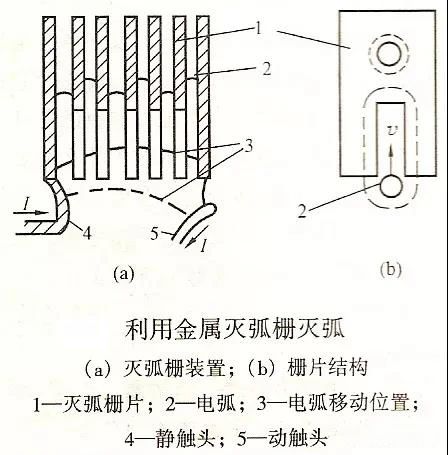
Arc-quenching grids are made of high-temperature-resistant insulating materials and come in several forms. The figure shows the simplest straight-slot type. The magnetic-blowout coil is connected in series or in parallel with the circuit. When the contacts open and an arc forms, the magnetic field of the coil exerts an electrodynamic force on the arc, drawing it into the narrow slots between the arc plates. The slots restrict the arc diameter and increase the pressure in the arc gap. At the same time, the arc is lengthened and brought into close contact with the cool walls of the arc plates, strengthening cooling and recombination within the arc, and ultimately extinguishing it.